What is Odysseus final destination in the Odyssey? (Where does he ultimately want to go?)
| Odysseus | |
|---|---|
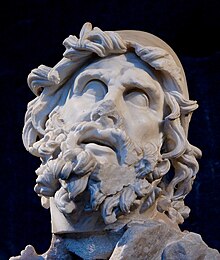 Head of Odysseus from a Roman menstruation Hellenistic marble group representing Odysseus blinding Polyphemus, found at the villa of Tiberius at Sperlonga, Italy | |
| Home | Ithaca, Hellenic republic |
| Personal information | |
| Parents | Laërtes Anticlea |
| Espoused | Penelope |
| Children | Telemachus Telegonus |
| Roman equivalent | Ulysses |
Odysseus ( ə-DISS-ee-əs;[1] Greek: Ὀδυσσεύς, Ὀδυσεύς , translit. Odysseús, Odyseús , IPA: [o.dy(s).sěu̯s]), likewise known past the Latin variant Ulysses ( yoo-LISS-eez, YOO-liss-eez; Latin: Ulysses, Ulixes), is a legendary Greek king of Ithaca and the hero of Homer's epic poem the Odyssey. Odysseus also plays a fundamental role in Homer's Iliad and other works in that same epic wheel.[2]
Son of Laërtes and Anticlea, husband of Penelope, and father of Telemachus and Acusilaus,[3] Odysseus is renowned for his intellectual brilliance, guile, and versatility (polytropos), and is thus known past the epithet Odysseus the Cunning (Greek: μῆτις , translit. mêtis , lit. "cunning intelligence"[4]). He is virtually famous for his nostos, or "homecoming", which took him ten eventful years after the decade-long Trojan State of war.
Name, etymology, and epithets [edit]
The form Ὀδυσ(σ)εύς Odys(south)eus is used starting in the ballsy period and through the classical menses, but various other forms are also found. In vase inscriptions, we notice the variants Oliseus ( Ὀλισεύς ), Olyseus ( Ὀλυσεύς ), Olysseus ( Ὀλυσσεύς ), Olyteus ( Ὀλυτεύς ), Olytteus ( Ὀλυττεύς ) and Ōlysseus ( Ὠλυσσεύς ). The form Oulixēs ( Οὐλίξης ) is attested in an early source in Magna Graecia (Ibycus, according to Diomedes Grammaticus), while the Greek grammarian Aelius Herodianus has Oulixeus ( Οὐλιξεύς ).[5] In Latin, he was known as Ulixēs or (considered less correct) Ulyssēs . Some have supposed that "in that location may originally have been two split figures, ane called something like Odysseus, the other something like Ulixes, who were combined into i complex personality."[half dozen] However, the modify between d and l is common too in some Indo-European and Greek names,[7] and the Latin grade is supposed to be derived from the Etruscan Uthuze (see below), which perhaps accounts for some of the phonetic innovations.
The etymology of the name is unknown. Ancient authors linked the proper name to the Greek verbs odussomai ( ὀδύσσομαι ) "to be wroth against, to hate",[8] to oduromai ( ὀδύρομαι ) "to lament, bewail",[nine] [x] or even to ollumi ( ὄλλυμι ) "to perish, to exist lost".[11] [12] Homer relates it to various forms of this verb in references and puns. In Volume 19 of the Odyssey, where Odysseus' early childhood is recounted, Euryclea asks the boy's grandfather Autolycus to proper name him. Euryclea seems to suggest a proper noun like Polyaretos, "for he has much been prayed for" (πολυάρητος) but Autolycus "apparently in a sardonic mood" decided to give the kid some other proper noun commemorative of "his ain feel in life":[13] "Since I have been angered (ὀδυσσάμενος odyssamenos) with many, both men and women, let the proper name of the kid be Odysseus".[14] Odysseus often receives the patronymic epithet Laertiades ( Λαερτιάδης ), "son of Laërtes". In the Iliad and Odyssey there are several further epithets used to describe Odysseus.
It has also been suggested that the proper noun is of not-Greek origin, maybe not even Indo-European, with an unknown etymology.[15] Robert Due south. P. Beekes has suggested a Pre-Greek origin.[16] In Etruscan religion the name (and stories) of Odysseus were adopted nether the name Uthuze (Uθuze), which has been interpreted every bit a parallel borrowing from a preceding Minoan form of the proper name (perchance *Oduze, pronounced /'ot͡θut͡se/); this theory is supposed to explain also the insecurity of the phonologies (d or 50), since the affricate /t͡θ/, unknown to the Greek of that time, gave rise to different counterparts (i. e. δ or λ in Greek, θ in Etruscan).[17]
Genealogy [edit]
Relatively little is given of Odysseus' background other than that according to Pseudo-Apollodorus, his paternal grandad or step-granddad is Arcesius, son of Cephalus and grandson of Aeolus, while his maternal grandfather is the thief Autolycus, son of Hermes[18] and Chione. Hence, Odysseus was the great-grandson of the Olympian god Hermes.
According to the Iliad and Odyssey, his father is Laertes[nineteen] and his mother Anticlea, although in that location was a non-Homeric tradition[20] [21] that Sisyphus was his true father.[22] The rumour went that Laërtes bought Odysseus from the conniving king.[23] Odysseus is said to take a younger sister, Ctimene, who went to Same to be married and is mentioned by the swineherd Eumaeus, whom she grew up alongside, in book fifteen of the Odyssey.[24]
Before the Trojan War [edit]
The majority of sources for Odysseus' pre-state of war exploits—principally the mythographers Pseudo-Apollodorus and Hyginus—postdate Homer past many centuries. Two stories in detail are well known:
When Helen of Troy is abducted, Menelaus calls upon the other suitors to laurels their oaths and assistance him to retrieve her, an attempt that leads to the Trojan State of war. Odysseus tries to avert it by feigning lunacy, as an oracle had prophesied a long-delayed return home for him if he went. He hooks a donkey and an ox to his plow (every bit they accept different stride lengths, hindering the efficiency of the plow) and (some modern sources add) starts sowing his fields with salt. Palamedes, at the behest of Menelaus' blood brother Agamemnon, seeks to disprove Odysseus' madness and places Telemachus, Odysseus' infant son, in front of the turn. Odysseus veers the plough away from his son, thus exposing his stratagem.[25] Odysseus holds a grudge confronting Palamedes during the war for dragging him away from his home.
Odysseus and other envoys of Agamemnon travel to Scyros to recruit Achilles because of a prophecy that Troy could not be taken without him. By most accounts, Thetis, Achilles' mother, disguises the youth as a woman to hibernate him from the recruiters because an oracle had predicted that Achilles would either live a long uneventful life or achieve everlasting glory while dying young. Odysseus cleverly discovers which among the women earlier him is Achilles when the youth is the only one of them to prove interest in examining the weapons hidden amidst an array of adornment gifts for the daughters of their host. Odysseus arranges further for the sounding of a battle horn, which prompts Achilles to clutch a weapon and bear witness his trained disposition. With his disguise foiled, he is exposed and joins Agamemnon's call to arms amongst the Hellenes.[26]
During the Trojan War [edit]
The Iliad [edit]

Odysseus is i of the about influential Greek champions during the Trojan War. Along with Nestor and Idomeneus he is one of the most trusted counsellors and advisors. He always champions the Achaean crusade, especially when others question Agamemnon's control, every bit in one instance when Thersites speaks against him. When Agamemnon, to test the morale of the Achaeans, announces his intentions to depart Troy, Odysseus restores order to the Greek camp.[27] Later on, after many of the heroes leave the battlefield due to injuries (including Odysseus and Agamemnon), Odysseus once once more persuades Agamemnon not to withdraw. Along with two other envoys, he is chosen in the failed embassy to endeavor to persuade Achilles to return to gainsay.[28]

Odysseus and Diomedes stealing the horses of Thracian rex Rhesus they take just killed. Apulian red-figure situla, from Ruvo
When Hector proposes a unmarried gainsay duel, Odysseus is one of the Danaans who reluctantly volunteered to battle him. Telamonian Ajax ("The Greater"), however, is the volunteer who eventually fights Hector.[29] Odysseus aids Diomedes during the nighttime operations to impale Rhesus, considering it had been foretold that if his horses drank from the Scamander River, Troy could not be taken.[30]
Later on Patroclus is slain, information technology is Odysseus who counsels Achilles to allow the Achaean men eat and residuum rather than follow his rage-driven desire to go dorsum on the offensive—and kill Trojans—immediately. Eventually (and reluctantly), he consents.[31] During the funeral games for Patroclus, Odysseus becomes involved in a wrestling lucifer with Ajax "The Greater" and pes race with Ajax "The Lesser," son of Oileus and Nestor's son Antilochus. He draws the wrestling lucifer, and with the help of the goddess Athena, he wins the race.[32]
Odysseus has traditionally been viewed as Achilles' antithesis in the Iliad:[33] while Achilles' anger is all-consuming and of a self-destructive nature, Odysseus is ofttimes viewed every bit a man of the mean, a voice of reason, renowned for his self-restraint and diplomatic skills. He is also in some respects antonymous to Telamonian Ajax (Shakespeare'southward "beefiness-witted" Ajax): while the latter has only brawn to recommend him, Odysseus is non only ingenious (every bit evidenced by his idea for the Trojan Horse), but an eloquent speaker, a skill peradventure best demonstrated in the embassy to Achilles in volume nine of the Iliad. The 2 are not only foils in the abstract but frequently opposed in practice since they accept many duels and run-ins.
Other stories from the Trojan War [edit]

Since a prophecy suggested that the Trojan War would non be won without Achilles, Odysseus and several other Achaean leaders went to Skyros to notice him. Odysseus discovered Achilles by offering gifts, adornments and musical instruments as well as weapons, to the king'south daughters, so having his companions imitate the noises of an enemy's attack on the island (most notably, making a boom of a trumpet heard), which prompted Achilles to reveal himself by picking a weapon to fight dorsum, and together they departed for the Trojan State of war.[35]
The story of the death of Palamedes has many versions. According to some, Odysseus never forgives Palamedes for unmasking his feigned madness and plays a part in his downfall. Ane tradition says Odysseus convinces a Trojan captive to write a letter pretending to be from Palamedes. A sum of gold is mentioned to have been sent as a reward for Palamedes' treachery. Odysseus so kills the prisoner and hides the gold in Palamedes' tent. He ensures that the letter of the alphabet is found and caused by Agamemnon, and also gives hints directing the Argives to the gold. This is testify plenty for the Greeks, and they have Palamedes stoned to death. Other sources say that Odysseus and Diomedes goad Palamedes into descending a well with the prospect of treasure being at the bottom. When Palamedes reaches the bottom, the two proceed to bury him with stones, killing him.[36]

Oinochoe, ca 520 BC, Odysseus and Ajax fighting over the armour of Achilles
When Achilles is slain in battle by Paris, it is Odysseus and Ajax who retrieve the fallen warrior'south body and armour in the thick of heavy fighting. During the funeral games for Achilles, Odysseus competes in one case once again with Ajax. Thetis says that the artillery of Achilles will go to the bravest of the Greeks, but just these ii warriors dare lay merits to that championship. The 2 Argives became embroiled in a heavy dispute well-nigh 1 some other's merits to receive the reward. The Greeks dither out of fear in deciding a winner, because they did not want to insult one and take him abandon the state of war effort. Nestor suggests that they allow the captive Trojans decide the winner.[37] The accounts of the Odyssey disagree, suggesting that the Greeks themselves hold a secret vote.[38] In any case, Odysseus is the winner. Enraged and humiliated, Ajax is driven mad past Athena. When he returns to his senses, in shame at how he has slaughtered livestock in his madness, Ajax kills himself by the sword that Hector had given him afterward their duel.[39]
Together with Diomedes, Odysseus fetches Achilles' son, Pyrrhus, to come to the aid of the Achaeans, because an oracle had stated that Troy could not exist taken without him. A swell warrior, Pyrrhus is too called Neoptolemus (Greek for "new warrior"). Upon the success of the mission, Odysseus gives Achilles' armour to him.
It is learned that the state of war can not exist won without the poisonous arrows of Heracles, which are owned by the abandoned Philoctetes. Odysseus and Diomedes (or, according to some accounts, Odysseus and Neoptolemus) go out to retrieve them. Upon their arrival, Philoctetes (withal suffering from the wound) is seen withal to be enraged at the Danaans, specially at Odysseus, for abandoning him. Although his first instinct is to shoot Odysseus, his acrimony is eventually diffused past Odysseus' persuasive powers and the influence of the gods. Odysseus returns to the Argive military camp with Philoctetes and his arrows.[40]
Perhaps Odysseus' most famous contribution to the Greek war effort is devising the strategem of the Trojan Horse, which allows the Greek army to sneak into Troy under encompass of darkness. Information technology is congenital by Epeius and filled with Greek warriors, led past Odysseus.[41] Odysseus and Diomedes steal the Palladium that lay inside Troy'southward walls, for the Greeks were told they could not sack the urban center without it. Some late Roman sources indicate that Odysseus schemed to kill his partner on the way back, only Diomedes thwarts this attempt.

"Cruel, mendacious Ulixes" of the Romans [edit]
Homer'due south Iliad and Odyssey portray Odysseus as a culture hero, but the Romans, who believed themselves the heirs of Prince Aeneas of Troy, considered him a villainous falsifier. In Virgil's Aeneid, written betwixt 29 and nineteen BC, he is constantly referred to as "vicious Odysseus" (Latin dirus Ulixes) or "deceitful Odysseus" (pellacis, fandi fictor). Turnus, in Aeneid, book 9, reproaches the Trojan Ascanius with images of rugged, forthright Latin virtues, declaring (in John Dryden's translation), "You shall non find the sons of Atreus here, nor demand the frauds of sly Ulysses fear." While the Greeks admired his cunning and deceit, these qualities did not recommend themselves to the Romans, who possessed a rigid sense of accolade. In Euripides' tragedy Iphigenia at Aulis, having convinced Agamemnon to consent to the sacrifice of his daughter, Iphigenia, to appease the goddess Artemis, Odysseus facilitates the immolation past telling Iphigenia'due south mother, Clytemnestra, that the girl is to exist wednesday to Achilles. Odysseus' attempts to avoid his sacred oath to defend Menelaus and Helen offended Roman notions of duty, and the many stratagems and tricks that he employed to get his way offended Roman notions of honour.
Journeying home to Ithaca [edit]
Odysseus is probably best known as the eponymous hero of the Odyssey. This epic describes his travails, which lasted for x years, as he tries to return home afterward the Trojan War and reassert his place equally rightful king of Ithaca.

On the fashion dwelling from Troy, afterward a raid on Ismarus in the land of the Cicones, he and his twelve ships are driven off grade by storms. They visit the lethargic Lotus-Eaters and are captured past the Cyclops Polyphemus while visiting his island. After Polyphemus eats several of his men, Polyphemus and Odysseus have a discussion and Odysseus tells Polyphemus his proper name is "Nobody". Odysseus takes a barrel of vino, and the Cyclops drinks it, falling asleep. Odysseus and his men have a wooden stake, ignite it with the remaining vino, and blind him. While they escape, Polyphemus cries in pain, and the other Cyclopes ask him what is wrong. Polyphemus cries, "Nobody has blinded me!" and the other Cyclopes think he has gone mad. Odysseus and his coiffure escape, but Odysseus rashly reveals his existent name, and Polyphemus prays to Poseidon, his father, to take revenge. They stay with Aeolus, the master of the winds, who gives Odysseus a leather bag containing all the winds, except the west wind, a gift that should have ensured a safe return home. However, the sailors heedlessly open the pocketbook while Odysseus sleeps, thinking that information technology contains gilt. All of the winds fly out, and the resulting tempest drives the ships dorsum the way they had come up, but every bit Ithaca comes into sight.
Afterward pleading in vain with Aeolus to aid them again, they re-embark and see the cannibalistic Laestrygonians. Odysseus' ship is the only one to escape. He sails on and visits the witch-goddess Circe. She turns half of his men into swine subsequently feeding them cheese and wine. Hermes warns Odysseus nearly Circe and gives him a drug chosen moly, which resists Circe's magic. Circe, being attracted to Odysseus' resistance, falls in honey with him and releases his men. Odysseus and his coiffure remain with her on the island for one year, while they feast and drinkable. Finally, Odysseus' men convince him to exit for Ithaca.
Guided past Circe's instructions, Odysseus and his coiffure cross the ocean and attain a harbor at the western edge of the earth, where Odysseus sacrifices to the dead and summons the spirit of the old prophet Tiresias for communication. Next Odysseus meets the spirit of his own mother, who had died of grief during his long absenteeism. From her, he learns for the beginning fourth dimension news of his own household, threatened by the greed of Penelope'south suitors. Odysseus besides talks to his fallen war comrades and the mortal shade of Heracles.
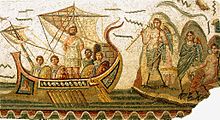
Odysseus and his men return to Circe's isle, and she advises them on the remaining stages of the journey. They brim the state of the Sirens, pass between the six-headed monster Scylla and the whirlpool Charybdis, where they row directly betwixt the two. However, Scylla drags the boat towards her by grabbing the oars and eats six men.
They state on the island of Thrinacia. There, Odysseus' men ignore the warnings of Tiresias and Circe and hunt down the sacred cattle of the sunday god Helios. Helios tells Zeus what happened and demands Odysseus' men be punished or else he will take the sun and shine it in the Underworld. Zeus fulfills Helios' demands by causing a shipwreck during a thunderstorm in which all but Odysseus drown. He washes aground on the isle of Ogygia, where Calypso compels him to remain equally her lover for seven years. He finally escapes when Hermes tells Calypso to release Odysseus.
Odysseus is shipwrecked and befriended by the Phaeacians. After he tells them his story, the Phaeacians, led by King Alcinous, agree to aid Odysseus get home. They evangelize him at night, while he is fast comatose, to a hidden harbor on Ithaca. He finds his mode to the hut of 1 of his own former slaves, the swineherd Eumaeus, and too meets upwardly with Telemachus returning from Sparta. Athena disguises Odysseus equally a wandering beggar to learn how things stand up in his household.
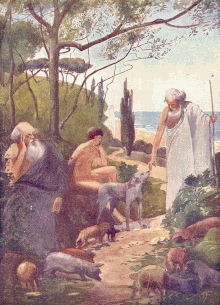
The render of Ulysses, illustration past E. M. Synge from the 1909 Story of the Globe children'southward book series (book ane: On the shores of Great Sea)
When the disguised Odysseus returns after 20 years, he is recognized simply by his faithful dog, Argos. Penelope announces in her long interview with the disguised hero that whoever can string Odysseus' rigid bow and shoot an arrow through twelve axe shafts may accept her paw. According to Bernard Knox, "For the plot of the Odyssey, of form, her decision is the turning point, the motility that makes possible the long-predicted triumph of the returning hero".[42] Odysseus' identity is discovered by the housekeeper, Eurycleia, every bit she is washing his anxiety and discovers an old scar Odysseus received during a boar chase. Odysseus swears her to secrecy, threatening to kill her if she tells anyone.
When the competition of the bow begins, none of the suitors is able to string the bow. Afterward all the suitors have given up, the disguised Odysseus asks to participate. Though the suitors refuse at commencement, Penelope intervenes and allows the "stranger" (the disguised Odysseus) to participate. Odysseus easily strings his bow and wins the competition. Having done and then, he gain to slaughter the suitors (commencement with Antinous whom he finds drinking from Odysseus' cup) with help from Telemachus and two of Odysseus' servants, Eumaeus the swineherd and Philoetius the cowherd. Odysseus tells the serving women who slept with the suitors to clean up the mess of corpses and then has those women hanged in terror. He tells Telemachus that he will furnish his stocks past raiding nearby islands. Odysseus has now revealed himself in all his glory (with a little makeover by Athena); however Penelope cannot believe that her married man has really returned—she fears that it is possibly some god in disguise, as in the story of Alcmene (female parent of Heracles)—and tests him by ordering her servant Euryclea to move the bed in their wedding-bedchamber. Odysseus protests that this cannot exist washed since he made the bed himself and knows that one of its legs is a living olive tree. Penelope finally accepts that he truly is her husband, a moment that highlights their homophrosýnē ("like-mindedness").
The next day Odysseus and Telemachus visit the country farm of his old father Laërtes. The citizens of Ithaca follow Odysseus on the road, planning to avenge the killing of the Suitors, their sons. The goddess Athena intervenes and persuades both sides to brand peace.
Other stories [edit]
Odysseus is i of the most recurrent characters in Western civilization.[ commendation needed ]
Classical [edit]
According to some late sources, virtually of them purely genealogical, Odysseus had many other children besides Telemachus. Almost such genealogies aimed to link Odysseus with the foundation of many Italic cities. The nearly famous being:
- with Penelope: Poliporthes (born after Odysseus' return from Troy)
- with Circe: Telegonus, Ardeas, Latinus, also Ausonus and Casiphone.[43] Xenagoras writes that Odysseus with Circe had 3 sons, Romos (Ancient Greek: Ῥώμος), Anteias (Ancient Greek: Ἀντείας) and Ardeias (Ancient Greek: Ἀρδείας), who built three cities and called them after their own names. The city that Romos founded was Rome.[44]
- with Calypso: Nausithous, Nausinous
- with Callidice: Polypoetes
- with Euippe: Euryalus
- with daughter of Thoas: Leontophonus
He figures in the end of the story of King Telephus of Mysia.
The supposed final poem in the Epic Cycle is called the Telegony and is thought to tell the story of Odysseus' last voyage, and of his death at the easily of Telegonus, his son with Circe. The verse form, similar the others of the cycle, is "lost" in that no authentic version has been discovered.
In 5th century BC Athens, tales of the Trojan State of war were popular subjects for tragedies. Odysseus figures centrally or indirectly in a number of the extant plays by Aeschylus, Sophocles (Ajax, Philoctetes) and Euripides (Hecuba, Rhesus, Cyclops) and figured in still more that have not survived. In his Ajax, Sophocles portrays Odysseus as a modern voice of reasoning compared to the championship character's rigid antiquity.
Plato in his dialogue Hippias Small-scale examines a literary question about whom Homer intended to portray as the better man, Achilles or Odysseus.
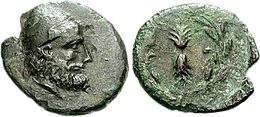
Head of Odysseus wearing a pileus depicted on a third-century BC coin from Ithaca
Pausanias at the Description of Hellenic republic writes that at Pheneus there was a statuary statue of Poseidon, surnamed Hippios (Ancient Greek: Ἵππιος), significant of horse, which according to the legends was dedicated by Odysseus and also a sanctuary of Artemis which was called Heurippa (Ancient Greek: Εὑρίππα), meaning horse finder, and was founded by Odysseus.[45] Co-ordinate to the legends Odysseus lost his mares and traversed the Greece in search of them. He found them on that site in Pheneus.[46] Pausanias adds that according to the people of Pheneus, when Odysseus found his mares he decided to keep horses in the country of Pheneus, simply as he reared his cows. The people of Pheneus also pointed out to him writing, purporting to be instructions of Odysseus to those disposed his mares.[47]
Every bit Ulysses, he is mentioned regularly in Virgil's Aeneid written between 29 and 19 BC, and the poem's hero, Aeneas, rescues one of Ulysses' crew members who was left behind on the island of the Cyclopes. He in plow offers a first-person account of some of the same events Homer relates, in which Ulysses appears straight. Virgil's Ulysses typifies his view of the Greeks: he is cunning but impious, and ultimately malicious and hedonistic.
Ovid retells parts of Ulysses' journeys, focusing on his romantic involvements with Circe and Calypso, and recasts him equally, in Harold Bloom's phrase, "1 of the great wandering womanizers". Ovid also gives a detailed account of the contest betwixt Ulysses and Ajax for the armour of Achilles.
Greek legend tells of Ulysses as the founder of Lisbon, Portugal, calling it Ulisipo or Ulisseya, during his twenty-twelvemonth errand on the Mediterranean and Atlantic seas. Olisipo was Lisbon'southward name in the Roman Empire. This folk etymology is recounted by Strabo based on Asclepiades of Myrleia'due south words, by Pomponius Mela, by Gaius Julius Solinus (3rd century AD), and will exist resumed by Camões in his epic poem Os Lusíadas (first printed in 1572).[ citation needed ]
Middle Ages and Renaissance [edit]
Dante Alighieri, in the Canto XXVI of the Inferno segment of his Divine Comedy (1308–1320), encounters Odysseus ("Ulisse" in Italian) near the very bottom of Hell: with Diomedes, he walks wrapped in flame in the eighth ring (Counselors of Fraud) of the Eighth Circumvolve (Sins of Malice), as punishment for his schemes and conspiracies that won the Trojan War. In a famous passage, Dante has Odysseus relate a dissimilar version of his voyage and death from the one told past Homer. He tells how he set out with his men from Circe's island for a journeying of exploration to sail beyond the Pillars of Hercules and into the Western body of water to find what adventures awaited them. Men, says Ulisse, are not fabricated to live similar brutes, but to follow virtue and knowledge.[48]
Later travelling west and southward for five months, they come across in the distance a great mountain rising from the body of water (this is Purgatory, in Dante'southward cosmology) before a storm sinks them. Dante did not have access to the original Greek texts of the Homeric epics, and then his cognition of their subject-matter was based only on data from later sources, chiefly Virgil's Aeneid but also Ovid; hence the discrepancy between Dante and Homer.
He appears in Shakespeare'southward Troilus and Cressida (1602), set during the Trojan State of war.
Modern literature [edit]
In her poem  Site of the Castle of Ulysses. (published in 1836), Letitia Elizabeth Landon gives her version of The Song of the Sirens with an explanation of its purpose, structure and meaning.

The bay of Palaiokastritsa in Corfu as seen from Bella vista of Lakones. Corfu is considered to exist the mythical island of the Phaeacians. The bay of Palaiokastritsa is considered to exist the place where Odysseus disembarked and met Nausicaa for the first fourth dimension. The stone in the sea visible almost the horizon at the top eye-left of the picture is considered past the locals to be the mythical petrified ship of Odysseus. The side of the stone toward the mainland is curved in such a style every bit to resemble the extended sail of a trireme.
Alfred, Lord Tennyson'due south poem "Ulysses" (published in 1842) presents an crumbling rex who has seen besides much of the world to be happy sitting on a throne idling his days away. Leaving the task of civilizing his people to his son, he gathers together a ring of old comrades "to sail across the sunset".
Frederick Rolfe'south The Weird of the Wanderer (1912) has the hero Nicholas Crabbe (based on the author) travelling back in time, discovering that he is the reincarnation of Odysseus, marrying Helen, being deified and catastrophe upward equally one of the iii Magi.
James Joyce's novel Ulysses (first published 1918–1920) uses modernistic literary devices to characterize a single twenty-four hours in the life of a Dublin man of affairs named Leopold Bloom. Bloom'southward mean solar day turns out to bear many elaborate parallels to Odysseus' ten years of wandering.
In Virginia Woolf'southward response novel Mrs Dalloway (1925) the comparable character is Clarissa Dalloway, who as well appears in The Voyage Out (1915) and several short stories.
Nikos Kazantzakis' The Odyssey: A Modernistic Sequel (1938), a 33,333-line epic poem, begins with Odysseus cleansing his body of the blood of Penelope'south suitors. Odysseus soon leaves Ithaca in search of new adventures. Before his death he abducts Helen, incites revolutions in Crete and Egypt, communes with God, and meets representatives of such famous historical and literary figures as Vladimir Lenin, Don Quixote and Jesus.
Return to Ithaca (1946) past Eyvind Johnson is a more realistic retelling of the events that adds a deeper psychological written report of the characters of Odysseus, Penelope, and Telemachus. Thematically, information technology uses Odysseus' backstory and struggle as a metaphor for dealing with the aftermath of war (the novel being written immediately afterward the end of the Second World War).
In the eleventh chapter of Primo Levi's 1947 memoir If This Is a Man, "The Canto of Ulysses", the writer describes the last voyage of Ulysses as told by Dante in The Inferno to a fellow-prisoner during forced labour in the Nazi concentration camp Auschwitz.
Odysseus is the hero of The Luck of Troy (1961) by Roger Lancelyn Green, whose title refers to the theft of the Palladium.
In 1986, Irish poet Eilean Ni Chuilleanain published "The Second Voyage", a poem in which she makes use of the story of Odysseus.
In S. Thou. Stirling'due south Isle in the Sea of Time (1998), offset part to his Nantucket series of alternate history novels, Odikweos ("Odysseus" in Mycenaean Greek) is a "historical" figure who is every bit every bit cunning as his legendary self and is one of the few Bronze Age inhabitants who discerns the time-travellers' real background. Odikweos first aids William Walker'southward rise to ability in Achaea and after helps bring Walker downwards subsequently seeing his homeland plough into a police land.
The Penelopiad (2005) by Margaret Atwood retells his story from the point of view of his married woman Penelope.
The literary theorist Núria Perpinyà conceived twenty dissimilar interpretations of the Odyssey in a 2008 study.[49]
Odysseus is likewise a character in David Gemmell's Troy trilogy (2005–2007), in which he is a good friend and mentor of Helikaon. He is known as the ugly king of Ithaka. His marriage with Penelope was arranged, but they grew to love each other. He is too a famous storyteller, known to exaggerate his stories and heralded as the greatest storyteller of his age. This is used every bit a plot device to explicate the origins of such myths as those of Circe and the Gorgons. In the serial, he is adequately old and an unwilling marry of Agamemnon.
In Madeline Miller's The Song of Achilles (a retelling of the Trojan State of war as well as the life of Patroclus and his romance with Achilles), Odysseus is a major character with much the same role he had in Homer's Iliad, though it is expanded upon. Miller's Circe tells of Odysseus'southward visit to Circe's isle from Circe'due south point of view, and includes the nativity of their son Telegonus, and Odysseus' inadvertent decease when Telegonus travels to Ithaca to see him.
Television and film [edit]
The actors who accept portrayed Odysseus in characteristic films include Kirk Douglas in the Italian Ulysses (1955), John Drew Barrymore in The Trojan Horse (1961), Piero Lulli in The Fury of Achilles (1962), and Sean Bean in Troy (2004).
In TV miniseries he has been played by Bekim Fehmiu in 50'Odissea (1968), Armand Assante in The Odyssey (1997), and past Joseph Mawle in Troy: Autumn of a Metropolis (2018).
Ulysses 31 is a French-Japanese blithe television series (1981) that updates the Greek mythology of Odysseus to the 31st century.[fifty]
Joel and Ethan Coen's flick O Brother Where Art Yard? (2000) is loosely based on the Odyssey. Even so, the Coens have stated that they had never read the epic. George Clooney plays Ulysses Everett McGill, leading a group of escapees from a concatenation gang through an take chances in search of the proceeds of an armoured truck heist. On their voyage, the gang encounter—amongst other characters—a trio of Sirens and a one-eyed bible salesman. The plot of their 2013 movie Inside Llewyn Davis includes elements of the epic, equally the hero, a former seaman, embarks on a torrid journey with a cat named Ulysses.[51]
Music [edit]
The British group Cream recorded the vocal "Tales of Brave Ulysses" in 1967 and the 2002 the U.S. progressive metal band Symphony 10 released a 24-minute adaption of the tale on their album The Odyssey. Suzanne Vega's song "Calypso" from 1987 album Solitude Continuing shows Odysseus from Calypso's indicate of view, and tells the tale of him coming to the island and his leaving.
Rolf Riehm composed an opera based on the myth, Sirenen – Bilder des Begehrens und des Vernichtens (Sirens – Images of Desire and Destruction) which premiered at the Oper Frankfurt in 2014.
Odysseus is featured in a poesy of the vocal 'Journey of the Magi' on Frank Turner'due south 2009 album Poesy of the Act.[52]
Comparative mythology [edit]
Over time, comparisons betwixt Odysseus and other heroes of different mythologies and religions take been fabricated.
Nala [edit]
A similar story exists in Hindu mythology with Nala and Damayanti where Nala separates from Damayanti and is reunited with her.[53] The story of stringing a bow is similar to the description in the Ramayana of Rama stringing the bow to win Sita's hand in spousal relationship.[54]
Aeneas [edit]
The Aeneid tells the story of Aeneas and his travels to what would become Rome. On his journey he as well endures strife comparable to that of Odysseus. Notwithstanding, the motives for both of their journeys differ as Aeneas was driven by this sense of duty granted to him past the gods that he must abide by. He too kept in mind the future of his people, fitting for the future Father of Rome.
Folkloristics [edit]
In folkloristics, the story of Odysseus'southward journeying back to his native Ithaca and wife Penelope corresponds to the tale type ATU 974, "The Homecoming Husband", of the international Aarne-Thompson-Uther Index for folktale classification.[55] [56] [57] [58]
Altars - Islands - Cities [edit]
Strabo writes that on Meninx (Aboriginal Greek: Μῆνιγξ) island, mod Djerba at Tunisia, at that place was an chantry of the Odysseus.[59]
Pliny the Elder writes that in Italy there were some small islands (modern Torricella, Praca, Caryatid and other rocks)[60] which were called Ithacesiae because of a watchtower that Odysseus built at that place.[61]
According to ancient Greek tradition, Odysseus founded a urban center in Iberia which was chosen Odysseia (Ὀδύσσεια)[62] [63] or Odysseis (Ὀδυσσεῖς)[64] which had a sanctuary of goddess Athena.[62] [63] [65] Ancient authors identified it with Olisipo (modern Lisbon), but modern researchers believe that fifty-fifty its beingness is uncertain.[65]
Namesakes [edit]
- Odysseus (crater)
- Prince Odysseas-Kimon of Hellenic republic and Denmark (born 2004), is the grandson of the deposed Greek king, Constantine Two.
- 1143 Odysseus
Run across besides [edit]
- Returns from Troy
- Odysseus Unbound
References [edit]
- ^ "Odysseus". Lexico UK English Dictionary. Oxford Academy Printing. n.d.
- ^ "Odysseus". Retrieved 24 April 2021.
- ^ Epic Bike. Fragments on Telegony, 2 as cited in Eustathias, 1796.35.
- ^ "μῆτις - Liddell and Scott's Greek-English Lexicon". Perseus Projection. Archived from the original on four September 2018. Retrieved 18 April 2018.
- ^ Entry " Ὀδυσσεύς ", in: Henry George Liddell and Robert Scott: A Greek–English Lexicon, 1940.
- ^ Stanford, William Bedell (1968). The Ulysses theme. A Study in the Adaptability of a Traditional Hero. New York: Spring Publications. p. 8.
- ^ Encounter the entry "Ἀχιλλεύς" in Wiktionary; cfr. Greek δάκρυ, dákru, vs. Latin lacrima "tear".
- ^ Entry " ὀδύσσομαι " in Liddell and Scott, A Greek–English Dictionary.
- ^ Entry " ὀδύρομαι " in Liddell and Scott, A Greek–English Dictionary.
- ^ Helmut van Thiel, ed. (2009). Homers Odysseen. Berlin: Lit. p. 194.
- ^ Entry " ὄλλυμι " in Liddell and Scott, A Greek–English Lexicon.
- ^ Marcy George-Kokkinaki (2008). Literary Anthroponymy: Decoding the Characters in Homer'southward Odyssey (PDF). Vol. iv. Antrocom. pp. 145–157. Retrieved 4 May 2017.
- ^ Stanford, William Bedell (1968). The Ulysses theme . p. 11.
- ^ Odyssey xix.400–405.
- ^ Dihle, Albrecht (1994). A History of Greek Literature. From Homer to the Hellenistic Catamenia. Translated by Clare Krojzl. London and New York: Routledge. p. 19. ISBN978-0-415-08620-two . Retrieved four May 2017.
- ^ Robert S. P. Beekes, Etymological Lexicon of Greek, Brill, Leiden 2009, p. 1048.
- ^ Glen Gordon, A Pre-Greek name for Odysseus, published at Paleoglot. Ancient languages. Aboriginal civilizations. Retrieved 4 May 2017.
- ^ Apollodorus, Bibliotheca Library one.9.xvi
- ^ Homer does non listing Laërtes as one of the Argonauts.
- ^ Scholium on Sophocles' Aiax 190, noted in Karl Kerényi, The Heroes of the Greeks, 1959:77.
- ^ "Spread by the powerful kings, // And by the kid of the infamous Sisyphid line" (κλέπτουσι μύθους οἱ μεγάλοι βασιλῆς // ἢ τᾶς ἀσώτου Σισυφιδᾶν γενεᾶς): Chorus in Ajax 189–190, translated past R. C. Trevelyan.
- ^ "A so-called 'Homeric' drinking-loving cup shows pretty undisguisedly Sisyphos in the bed-sleeping accommodation of his host'southward daughter, the arch-rogue sitting on the bed and the girl with her spindle." The Heroes of the Greeks 1959:77.
- ^ "Sold by his father Sisyphus" (οὐδ᾽ οὑμπολητὸς Σισύφου Λαερτίῳ): Philoctetes in Philoctetes 417, translated by Thomas Francklin.
- ^ "Women in Homer's Odyssey". Records.viu.ca. xvi September 1997. Archived from the original on 4 Oct 2011. Retrieved 25 September 2011.
- ^ Hyginus, Fabulae 95. Cf. Apollodorus, Image iii.7.
- ^ Hyginus, Fabulae 96.
- ^ Iliad 2.
- ^ Iliad 9.
- ^ Iliad 7.
- ^ Iliad ten.
- ^ Iliad xix.
- ^ Iliad 23.
- ^ D. Gary Miller (2014 ), Ancient Greek Dialects and Early on Authors, De Gruyter ISBN 978-one-61451-493-0. pp. 120-121
- ^ Documentation on the "Villa romana de Olmeda", displaying a photo of the whole mosaic, entitled "Aquiles en el gineceo de Licomedes" (Achilles in Lycomedes' 'seraglio').
- ^ Achilleid, book ane.
- ^ Apollodorus, Epitome 3.eight; Hyginus 105.
- ^ Scholium to Odyssey 11.547.
- ^ Odyssey 11.543–47.
- ^ Sophocles, Ajax 662, 865.
- ^ Apollodorus, Paradigm 5.eight.
- ^ See, e.thou., Odyssey 8.493; Apollodorus, Epitome 5.14–15.
- ^ Bernard Knox (1996): Introduction to Robert Fagles' translation of The Odyssey, p. 55.
- ^ "Chiliades, 5.23 lines 568-570".
- ^ "Dionysius of Halicarnassus, Roman Antiquities, one.72.5".
- ^ "Pausanias, Description of Greece, 8.14.5".
- ^ "Pausanias, Description of Greece, 8.14.5".
- ^ "Pausanias, Clarification of Greece, 8.14.vi".
- ^ Dante, Divine Comedy, canto 26: "fatti non-foste a viver come bruti / ma per seguir virtute e conoscenza".
- ^ Núria Perpinyà (2008): The Crypts of Criticism: Twenty Readings of The Odyssey (Spanish original: Las criptas de la crítica: veinte lecturas de la Odisea, Madrid, Gredos).
- ^ "Ulysses 31 webpage".
- ^ Smith, Kyle (5 Dec 2013). "Coen brothers' 'Within Llewyn Davis' hits the correct notes". New York Post . Retrieved five September 2020.
- ^ "Genius Lyrics - Frank Turner, Journeying of the Magi". Genius Lyrics . Retrieved 26 April 2021.
- ^ Wendy Doniger (1999). Splitting the difference: gender and myth in aboriginal Greece and India. Academy of Chicago Press. ISBN978-0-226-15641-5. pp. 157ff
- ^ Harry Fokkens; et al. (2008). "Bracers or bracelets? About the functionality and pregnant of Bell Beaker wrist-guards". Proceedings of the Prehistoric Gild. Academy of Leiden. 74. p. 122.
- ^ Clark, Raymond J. "The Returning Husband and the Waiting Married woman: Folktale Adaptations in Homer, Tennyson and Pratt". In: Folklore 91, no. 1 (1980): 46–62. http://www.jstor.org/stable/1259818.
- ^ Set up, JONATHAN Fifty. "ATU 974 THE HOMECOMING HUSBAND, THE RETURNS OF ODYSSEUS, AND THE Terminate OF ODYSSEY 21.". In: Arethusa 47, no. 3 (2014): 265–85. https://www.jstor.org/stable/26314683.
- ^ Shaw, John. "Mythological Aspects of the 'Render Vocal' Theme and their Counterparts in Due north-western Europe". In: Nouvelle Mythologie Comparée nº. 6 (2021).
- ^ Hansen, William P. Ariadne's Thread: A Guide to International Tales Found in Classical Literature. Cornell University Press, 2002. pp. 202-210. ISBN 9780801436703.
- ^ "Strabo, Geography, §17.three.17".
- ^ "Pliny the Elder, Natural History, three.13, note 21".
- ^ "Pliny the Elder, Natural History, 3.13".
- ^ a b http://www.perseus.tufts.edu/hopper/text?doc=urn:cts:greekLit:tlg0099.tlg001.perseus-grc1:3.4.3 Strabo, Geography, iii.2.13
- ^ a b Strabo, Geography, 3.4.3
- ^ Stephanus of Byzantium, Ethnica, O484.7
- ^ a b Dictionary of Greek and Roman Geography (1854), Odysseia
Farther reading [edit]
- Tole, Vasil Due south. (2005). Odyssey and Sirens: A Temptation towards the Mystery of the Iso-polyphonic Regions of Epirus. A Homeric theme with variations. Tirana, Albania. ISBN99943-31-63-9.
- Bittlestone, Robert; Diggle, James; Underhill, John (2005). Odysseus Unbound: The Search for Homer'south Ithaca . Cambridge, UK: Cambridge University Press. ISBN0-521-85357-5 . Retrieved 13 February 2021. (Odysseus Unbound Foundation)
- Bradford, Ernle (1963). Ulysses Establish. Hodder & Stoughton.
External links [edit]
 | Wikimedia Eatables has media related to Odysseus. |
- "Archaeological discovery in Greece may exist the tomb of Odysseus" from the Madera Tribune
- Chisholm, Hugh, ed. (1911). . Encyclopædia Britannica (11th ed.). Cambridge University Printing.
hornpingerced1936.blogspot.com
Source: https://en.wikipedia.org/wiki/Odysseus
0 Response to "What is Odysseus final destination in the Odyssey? (Where does he ultimately want to go?)"
Post a Comment