Html Upload Pdf File and Allow Scrolling
PDF files are ordinarily used in many businesses today — whether you want to generate sales reports, deliver contracts, or send invoices, PDF is the file blazon of choice. In an earlier mail service, we looked at a native solution that works on many browsers without the use of JavaScript or any 3rd-political party browser plugins.
In this tutorial, nosotros'll go a bit deeper and examine i of the most popular open source libraries for rendering PDF files in the browser: PDF.js. Nosotros'll walk you through how to render a PDF and how to embed a PDF viewer in the browser, and at the end, we'll discuss cases in which you should opt for a commercial Javascript PDF Viewer.
Displaying a PDF in the Browser with PDF.js
PDF.js is a JavaScript library written by Mozilla. Since it implements PDF rendering in vanilla JavaScript, it has cantankerous-browser compatibility and doesn't require boosted plugins to be installed. We suggest carefully testing correctness, as there are many known problems with the render fidelity of PDF.js.
How Does PDF.js Handle PDFs?
With PDF.js, PDFs are downloaded via AJAX and rendered in a <sail> element using native drawing commands. To ameliorate performance, a lot of the processing work happens in a web worker, where the work of the cadre layer commonly takes identify.
PDF.js consists of three unlike layers:
-
Core — The binary format of a PDF is interpreted in this layer. Using the layer directly is considered advanced usage.
-
Display — This layer builds upon the core layer and exposes an easy-to-employ interface for almost twenty-four hour period-to-solar day work.
-
Viewer — In addition to providing a programmatic API, PDF.js also comes with a ready-to-use user interface that includes support for search, rotation, a thumbnail sidebar, and many other things.
To get started, all you need to practice is to download a contempo copy of PDF.js and you're good to go!

Rendering a PDF
To return a specific page of a PDF into a <canvas> element, we can employ the display layer. We first extract all the files in the downloaded copy of PDF.js, just we currently but demand the files pdf.js and pdf.worker.js from the build/ folder of the download. We motility these files into a new empty directory, which allows us to create a simple.js and a elementary.html file.
The HTML file needs to point to the pdf.js source lawmaking and to our custom application lawmaking (unproblematic.js). We also create a <canvas> element, which nosotros desire the showtime page of the PDF to be rendered into:
<!-- simple.html --> <!DOCTYPE html> <html> <head> <meta charset="UTF-viii" /> <title>PDF.js Case</championship> <script src="/pdf.js"></script> <script src="/simple.js"></script> </head> <trunk> <sheet id="pdf"></canvas> </body> </html>
Now all that's missing is our simple.js code that leverages the PDF.js API to return the first page. This API makes heavy use of Promise, a JavaScript feature for treatment future values. If you're not familiar with this blueprint, y'all should check out the MDN web docs.
The getDocument(url) method can be used to initialize a PDF certificate from a URL. From at that place, we can access a unmarried page via the folio(pageNumber) method (pageNumber starts at ane for the get-go page, etc.). The getViewport(scale) method can exist used to get the dimensions of a PDF that are multiplied by the scale factor. We use the viewport information to ready the dimensions of the <canvas> element and can then starting time the page renderer with the render(options) API:
// unproblematic.js (async () => { const loadingTask = PDFJS.getDocument('/exam.pdf'); const pdf = await loadingTask.promise; // Load information from the first folio. const page = look pdf.getPage(1); const scale = 1; const viewport = page.getViewport(scale); // Apply page dimensions to the `<canvas>` element. const canvas = document.getElementById('pdf'); const context = canvas.getContext('2d'); canvas.top = viewport.height; canvas.width = viewport.width; // Return the page into the `<canvas>` element. const renderContext = { canvasContext: context, viewport: viewport, }; look page.return(renderContext); panel.log('Page rendered!'); })();
// simple.js var loadingTask = PDFJS.getDocument('/test.pdf'); loadingTask.promise.and so( part (pdf) { // Load information from the starting time page. pdf.getPage(1).then(part (folio) { var scale = ane; var viewport = page.getViewport(calibration); // Use page dimensions to the `<canvas>` element. var canvass = document.getElementById('pdf'); var context = canvas.getContext('2nd'); canvas.peak = viewport.height; sheet.width = viewport.width; // Render the page into the `<canvass>` element. var renderContext = { canvasContext: context, viewport: viewport, }; folio.render(renderContext).and then(function () { console.log('Folio rendered!'); }); }); }, office (reason) { panel.error(reason); }, );
Before yous run this code, brand sure to re-create a PDF file into the folder and rename it to exam.pdf.
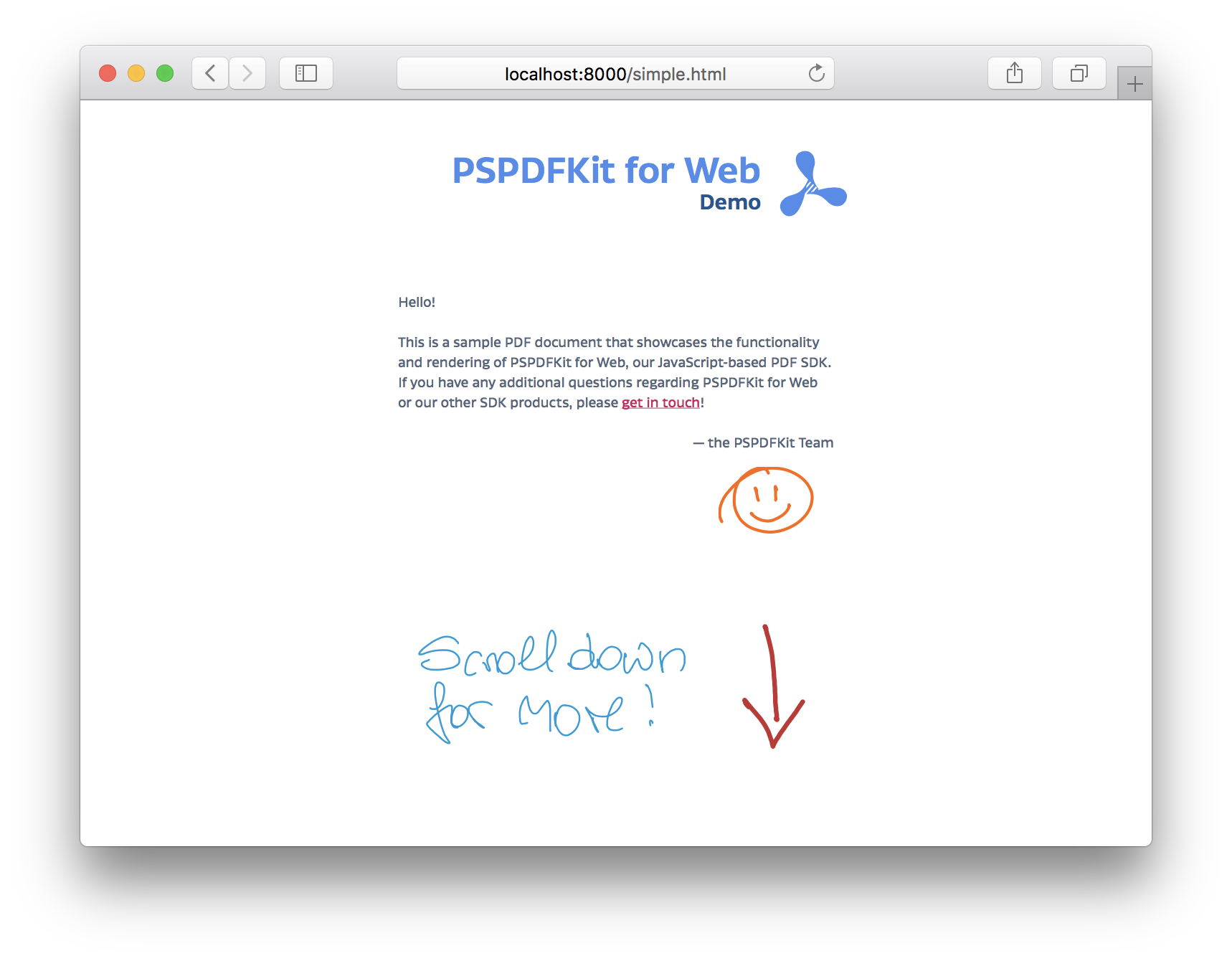
Then, to run this code, kickoff a web server in your test directory. If you're on a system that has a recent version of Python preinstalled (like macOS), you tin utilize python -m SimpleHTTPServer 8000. Next, open the instance at localhost:8000/simple.html.
Embedding the PDF Viewer in an HTML Window
While the display layer provides fine-grained control over which parts of a PDF certificate are rendered, there are times when nosotros prefer a fix-to-use viewer. Luckily, PDF.js has us covered. In this part, we'll integrate the PDF.js default viewer into our website.
Looking at the downloaded files, nosotros see some other directory, spider web/. In this directory, we can find all necessary files for the viewer. We copy the unabridged folder into a new directory chosen viewer/ (which results in files like viewer/web/viewer.js).
Just similar in the previous example, nosotros need the JavaScript files of PDF.js. To fix this up correctly, we create the build/ folder inside viewer/ and copy the files at that place, which results in viewer/build/pdf.js and viewer/build/pdf.worker.js.
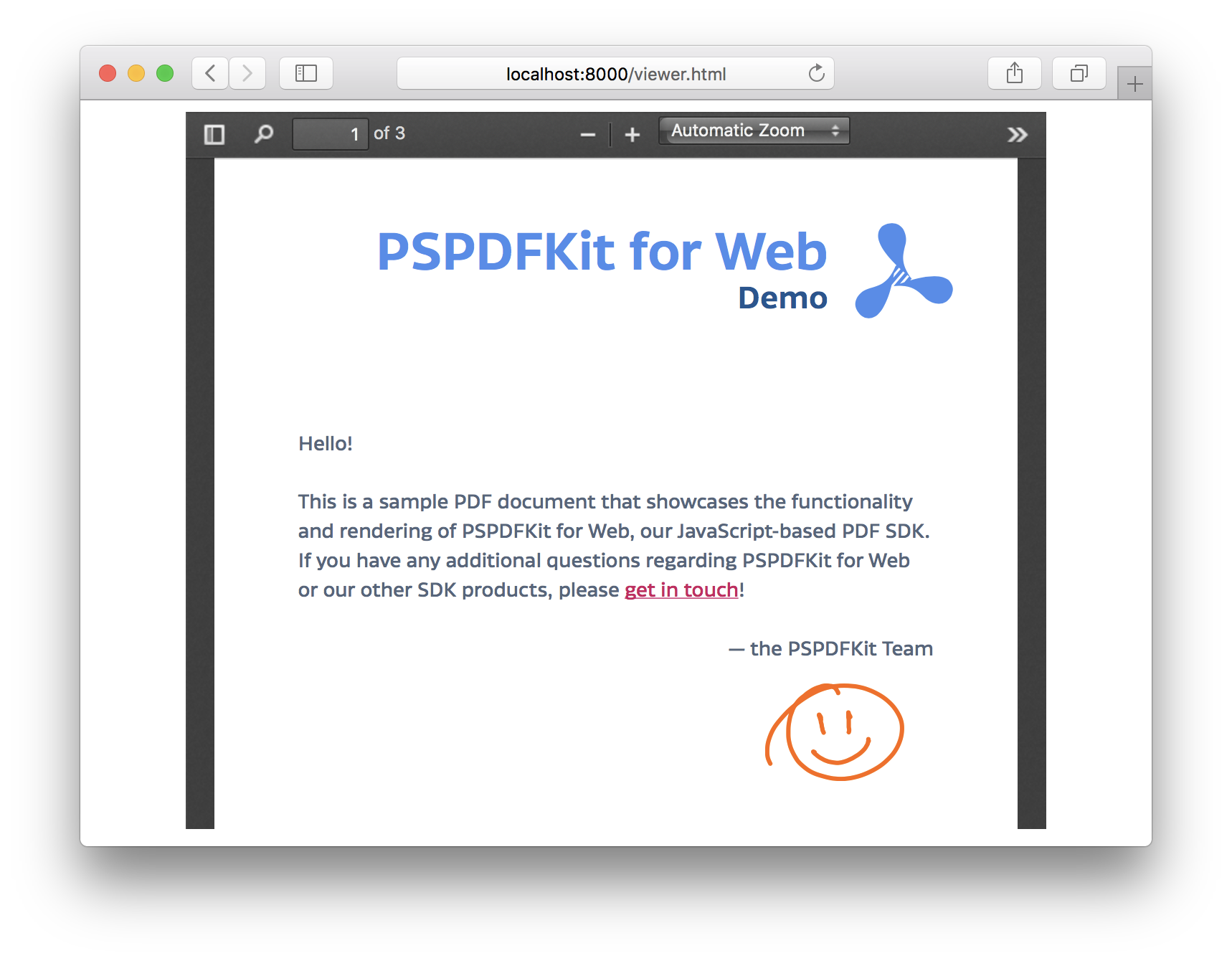
We can now work on the integration. To do this, we create a elementary HTML file that volition include the viewer via an <iframe>. This allows u.s. to embed the viewer into an existing webpage very hands. The viewer is configured via URL parameters, a listing of which tin exist constitute hither. For our instance, we'll only configure the source PDF file. For more than advanced features (like saving the PDF document to your web server again), y'all can start modifying the viewer.html file provided by PDF.js:
<!DOCTYPE html> <html> <head> <meta charset="UTF-8" /> <title>PDF.js Example</title> </caput> <body> <iframe src="/web/viewer.html?file=/test.pdf" width="800px" elevation="600px" style="border: none;" /> </body> </html>
This tiny block of HTML is indeed all that'due south needed to start working, and all of the PDF.js code is handled conveniently via the viewer.html file delivered by PDF.js. Now copy a PDF file to viewer/test.pdf and start a elementary HTTP server inside the viewer/ directory once again.
Conclusion
The iii layers of PDF.js are nicely separated, assuasive yous to focus on the parts you really demand. The core layer handles the heavy PDF.js parsing — an operation which usually takes place in a web worker. This helps keep the primary thread responsive at all times. The brandish layer exposes an interface to hands render a PDF, and you tin employ this API to render a folio into a <sail> chemical element with only a couple of lines of JavaScript. The third layer, viewer, builds upon the other layers and provides a simple merely constructive user interface for showing PDF documents in a web browser.
All in all, PDF.js is a bang-up solution for many use cases. Yet, sometimes your business concern requires more than complex features, such as the following, for treatment PDFs in the browser:
-
PDF annotation support — PDF.js will only return annotations that were already in the source file, and you tin can utilize the core API to admission raw annotation information. It doesn't have annotation editing support, so your users won't exist able to create, update, or delete annotations to review a PDF document.
-
PDF form filling — While PDF.js has started working with interactive forms, our testing found that there are nonetheless a lot of issues left open. For instance, form buttons and deportment aren't supported, making it impossible to submit forms to your web service.
-
Mobile support — PDF.js comes with a make clean mobile interface, merely it misses features that provide a great user experience and are expected nowadays, like pinch-to-zoom. Additionally, downloading an entire PDF document for mobile devices might outcome in a big operation penalty.
-
Persistent management — With PDF.js, there's no option to easily share, edit, and annotate PDF documents across a broad multifariousness of devices (whether information technology exist other web browsers, native apps, or more). If your business relies on this service, consider looking into a defended annotation syncing framework like PSPDFKit Instant.
-
Digital signatures — PDF.js currently has no support for digital signatures, which are used to verify the authenticity of a filled-out PDF.
-
Advanced view options — The PDF.js viewer only supports a continuous page view mode, wherein all pages are laid out in a listing and the user tin can scroll through them vertically. Single- or double-folio modes — where only 1 (or 2) pages are shown at in one case (a common option to arrive easier to read books or magazines) — aren't possible.
-
Return fidelity - In that location are many known problems with the render allegiance of PDF.js, where PDFs await different, have different colors or shapes, or even miss parts of the document altogether.
If your business relies on whatever of the higher up features, consider looking into alternatives. We at PSPDFKit work on the next generation of PDF viewers for the web. Together with PSPDFKit Instant, nosotros offering an enterprise-ready PDF solution for web browsers and other platforms, along with industry-leading start-form support included with every plan. Launch our Web demo to see PSPDFKit for Web in action.
hornpingerced1936.blogspot.com
Source: https://pspdfkit.com/blog/2018/render-pdfs-in-the-browser-with-pdf-js/
0 Response to "Html Upload Pdf File and Allow Scrolling"
Post a Comment